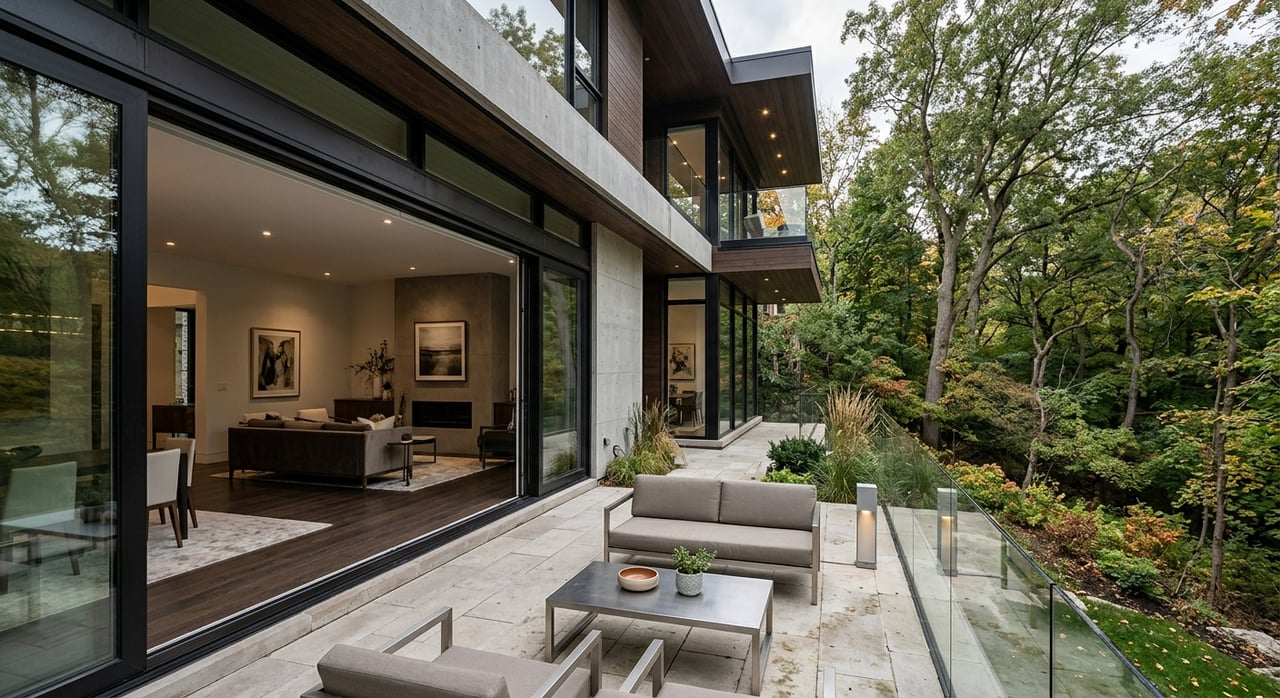
If you want a Toronto neighbourhood that feels tucked into nature without cutting you off from the rest of the city, Hoggs Hollow stands out fast. You may be looking for privacy, larger lots, and a setting that feels calmer than a typical urban grid, but you still need practical access for commuting, errands, and daily routines. That mix is exactly why Hoggs Hollow continues to draw attention from buyers who care as much about landform and setting as they do about the house itself. Let’s take a closer look.
Why Hoggs Hollow feels different
Hoggs Hollow is one of Toronto’s most distinct ravine neighbourhoods. Its identity is closely tied to the Don River valley, and that connection shows up in both the landscape and the planning framework that shapes the area.
The neighbourhood’s roots go back to the Hogg family’s arrival in 1824, with an 1856 subdivision plan that introduced the Hogg’s Hollow name. That history still matters because the area is not just another low-rise pocket. It is a place where topography, mature trees, and winding streets have helped define the character over time.
Ravine setting shapes daily life
One of the first things you notice in Hoggs Hollow is that the streets do not read like a standard city grid. Planning and heritage records describe a garden-suburb setting with curving roads, cul-de-sacs, mature landscaping, and a natural valley context.
For you as a buyer, that often translates into a different day-to-day experience. The appeal here is less about constant commercial activity and more about quiet residential streets, visual privacy, and homes that sit within the land rather than dominating it.
Homes and lots in Hoggs Hollow
Hoggs Hollow falls within Toronto’s broader Neighbourhoods designation, which the City describes as low-scale areas made up of housing forms such as detached homes, semi-detached homes, duplexes, triplexes, townhouses, and small-scale local uses. In practice, the area is especially known for detached homes on generous lots.
A Toronto Local Appeal Body decision that summarized a 344-lot study area found that spacious dwellings on large, deep lots are a defining feature. About 93% of those lots were at least 15 metres wide, roughly 54% were at least 50 metres deep, and around 64% were at least 1,000 square metres.
That data helps explain why Hoggs Hollow often feels so private. You are not just buying square footage inside the home. In many cases, you are buying setback, tree canopy, depth, and breathing room around the house.
What the lot pattern means for buyers
Large and sometimes irregular lots can create real upside, especially if you value outdoor space, a more secluded setting, or a home that feels established rather than tightly packed. They can also influence how a property is renovated, expanded, or rebuilt over time.
The same study record noted that two-storey detached dwellings are the most common replacement form in the area. That tells you the neighbourhood continues to evolve, but usually within a detached-home framework rather than through dense redevelopment.
Access is a major advantage
A big part of Hoggs Hollow’s appeal is that it offers a calm internal feel while staying connected to key Toronto routes. That balance is not always easy to find.
York Mills Station acts as the main transit anchor for the area. The TTC lists Line 1 service there, along with a GO bus terminal at the northeast corner of Yonge and York Mills and several surface routes including 95 York Mills, 96 Wilson, 97 Yonge, 995 York Mills Express, and 996 Wilson Express.
As of June 2026, the Old York Mills Road entrance is closed until Fall 2026. Right now, station access is through the York Mills Centre side, which is worth knowing if you expect to use transit regularly.
Roads and commuting
At the road level, Hoggs Hollow sits beside a major commuter edge. City staff describe Yonge Street as a six-lane north-south arterial, and the Yonge Street and Highway 401 connection as a full-move interchange.
For you, that can mean strong regional access by car while the interior streets remain much quieter and more residential in character. It also means the edge near Yonge and 401 can feel more traffic-intensive than the heart of the neighbourhood itself.
Everyday errands and convenience
Hoggs Hollow is not defined by a busy pedestrian retail strip. Instead, daily convenience tends to come from nearby service and shopping nodes at the edge of the neighbourhood.
York Mills Centre is one of the clearest examples. The complex describes TTC and GO access on site, direct access to Highway 401, restaurants and cafés, a fitness facility, on-site green space, and a broad retail mix.
Bayview Village is another nearby anchor for shopping and dining. It describes itself as a walkable retail environment with a curated mix of retailers and restaurants, giving you another practical option for errands and outings.
What everyday life usually feels like
Official City records point to a rhythm centered more on residential calm and green space than on constant street-level activity. A 2018 City traffic-calming report described Hoggs Hollow as mainly residential and noted that it also includes several parks, a school, and a golf club.
That matters if you are trying to picture your routine. In Hoggs Hollow, you are more likely to experience a quieter residential setting with purposeful trips out for shopping, dining, and transit rather than a neighbourhood built around all-day foot traffic.
Green space is central here
In many Toronto neighbourhoods, green space is a bonus. In Hoggs Hollow, it is part of the identity.
The City notes that Don Valley Golf Course sits alongside the Don River and offers natural views. It is also Toronto’s longest golf course at 6,163 yards, which reinforces how closely recreation here ties into the valley landscape.
York Mills Valley Park is another local recreational reference point in City listings. Together, these features support the idea that living in Hoggs Hollow often means having everyday contact with ravine landform, mature vegetation, and open green space.
Planning matters more here
If you are considering a renovation, addition, or rebuild, Hoggs Hollow is a place where planning context deserves careful attention. This is not just a design conversation. It is also a site and policy conversation.
The area is identified under the Don River West Branch Special Policy Area in Toronto’s Official Plan mapping. The City explains that Special Policy Areas are communities that historically existed in floodplains, where stricter controls would otherwise create significant social and economic hardship and where site-specific policies apply.
The City also treats ravines, watercourses, and buffer areas as protected features through hazard management and setback planning. In practical terms, that means property changes in Hoggs Hollow can be more sensitive to floodplain context, buffers, and site-specific review than they would be in a flatter low-rise neighbourhood.
Why this matters when you buy
If you are buying with long-term plans, it helps to look beyond finishes and layout. You also want to understand how the lot sits within the ravine setting and what that may mean for future changes.
This is where careful neighbourhood guidance becomes especially valuable. In a place like Hoggs Hollow, the setting creates much of the value, but it also shapes what is feasible when you think about additions, new construction, or major updates.
Who Hoggs Hollow tends to suit
Hoggs Hollow can make sense if you want a home that feels private and established, with mature landscaping and a less standardized streetscape. It may also appeal to you if commuter access matters, but you do not want your everyday environment to feel dense or overly busy.
It is often a strong fit for buyers who notice things like lot depth, siting, tree cover, and the relationship between the house and the land. In this neighbourhood, those details are not secondary. They are a major part of the draw.
The bigger takeaway
Hoggs Hollow offers something specific in Toronto: a ravine-defined residential setting with large-lot character and strong city access. The neighbourhood is not about a fast urban pace. Its value comes from privacy, topography, mature landscape, and the unusual feeling of being buffered from the city while still staying connected to it.
If that combination is what you are after, Hoggs Hollow deserves a serious look. And if you are weighing not just lifestyle but also lot quality, planning context, and long-term value, a more precise reading of the neighbourhood can make a real difference.
If you are exploring Hoggs Hollow or comparing it with other high-value Toronto neighbourhoods, Kristian Utley can help you assess the setting, the property, and the strategy behind the move.
FAQs
What is Hoggs Hollow known for in Toronto?
- Hoggs Hollow is known for its ravine setting, mature trees, curving residential streets, and large, deep lots that create a private and established feel.
How do you get around from Hoggs Hollow?
- York Mills Station is the main transit hub, with Line 1 subway service, a GO bus terminal, and several TTC routes, while Yonge Street and Highway 401 provide strong road access.
What kind of homes are common in Hoggs Hollow?
- Detached homes are the defining housing form in the area, and planning records describe spacious dwellings on wide, deep lots as a key neighbourhood characteristic.
Is Hoggs Hollow walkable for errands and shopping?
- Daily errands usually rely on nearby service hubs such as York Mills Centre and Bayview Village rather than a traditional main street running through the neighbourhood.
Why does planning context matter in Hoggs Hollow?
- Hoggs Hollow sits within a Special Policy Area tied to the Don River West Branch, and the ravine and floodplain setting can affect renovation, addition, and rebuild considerations.
What makes Hoggs Hollow different from other Toronto neighbourhoods?
- Its distinctiveness comes from the combination of ravine topography, generous lot sizes, mature landscaping, and convenient access to transit and major commuter routes.