Looking for a neighbourhood that feels designed rather than merely developed? Forest Hill stands out in Toronto because its character was shaped early, and much of that structure still shows today. If you care about architecture, streetscape, and long-term value as much as square footage, this guide will help you understand what makes Forest Hill distinct. Let’s dive in.
Why Forest Hill Feels Different
Forest Hill is not just a prestigious Toronto neighbourhood. It is a place where planning history, architecture, and village-scale retail come together in a way that feels unusually cohesive. The area includes a compact village core along Spadina Road and Lonsdale Avenue, within a broader residential fabric framed by Cedarvale Ravine, Avenue Road, St. Clair Avenue West, and Briar Hill Avenue.
That sense of order is rooted in how the neighbourhood was built. Forest Hill was incorporated as a village in 1923, and early development was shaped by strict by-laws, minimum construction costs, architect-designed front elevations, and a Board of Architects that reviewed new residential construction. For a design-minded buyer, that matters because the built environment was never meant to be random.
Forest Hill Village Character
The village core is intentionally small in scale. Toronto heritage material notes that the historic shopping heart is a compact two-block stretch north of St. Clair on Spadina Road, with commercial uses concentrated around the four corners of Spadina Road and Lonsdale Avenue. That compact footprint helps the area feel walkable and visually consistent.
Today, the Forest Hill Village BIA says the district includes more than 60 unique merchants. These range from cafés and restaurants to boutiques, galleries, professional services, and wellness businesses. For you as a buyer, that means the area supports daily convenience without feeling like a large commercial strip.
The streetscape is also under active planning attention. The City of Toronto is reviewing the Forest Hill Village Urban Design Guidelines and the St. Clair Avenue West and Bathurst Street Planning Framework to help keep future growth compatible with the area’s retail and streetscape character, especially near higher-order transit. That ongoing review reinforces an important point: the look and feel of Forest Hill is something the City is actively working to protect and manage.
Forest Hill Architecture and Homes
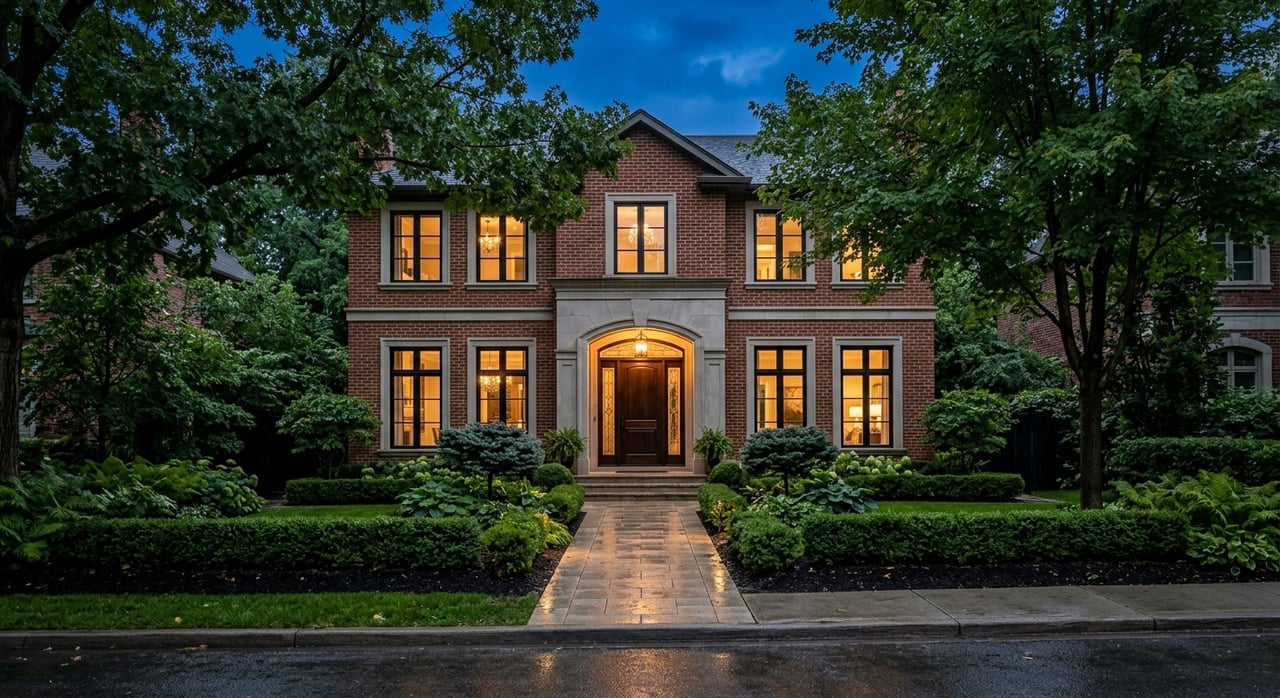
Forest Hill does not offer one single house type. Instead, the area is known for architect-designed period-revival homes, with official heritage decisions identifying Tudor Revival, Arts and Crafts with Tudor Revival details, and Georgian or Colonial Revival examples. This creates a neighbourhood with a strong visual language, but still enough variation to keep it interesting.
On the ground, that often means large landscaped lots, deep setbacks, mature trees, and a strong emphasis on craftsmanship. In practical terms, buyers here are often evaluating more than interior finishes. You are also paying for composition, setting, proportions, and architectural integrity.
Specific heritage properties help show the range. City records describe 63 Old Forest Hill Road as a grand Tudor Revival house shaped by Arts and Crafts principles, while 276 Forest Hill Road is identified as a Modern Georgian example. These examples support the broader pattern: Forest Hill rewards buyers who notice detail.
What Design-Minded Buyers Should Notice
If you are touring homes in Forest Hill, it helps to look beyond renovated kitchens and staged living rooms. In this neighbourhood, the more meaningful value often sits in things that are harder to replicate later. Lot shape, setback, natural light, façade balance, mature landscaping, and the relationship between the home and the street all play a role.
The planning and heritage context also suggests why certain homes feel more enduring than trend-driven. Much of the neighbourhood was built with architectural oversight and a clear expectation of design quality. That history still influences how the area reads today, even when homes have been updated over time.
A design-minded search here is often about identifying which properties preserve the strongest original bones and which ones have been adapted in a way that respects the home’s character. That is especially relevant in a neighbourhood where architectural coherence is part of the value story.
Condos and Apartments in Forest Hill
Forest Hill is not a tower-heavy condo district in the way some central Toronto luxury areas are. According to the City’s planning framework, the surrounding residential neighbourhood includes single and semi-detached houses, townhouses, and walk-up apartment buildings, while low-rise, mid-rise, and taller buildings are more concentrated closer to major corridors.
For you, that usually means condo and apartment options are more likely to be boutique, low-rise, or corridor-based rather than dominated by large high-rise inventory deep inside the neighbourhood. If your definition of design includes scale, proportion, and quieter residential context, that distinction may be a meaningful advantage.
The apartment presence here is also not new. City guidelines say apartment buildings were strategically encouraged in the village, particularly along Eglinton Avenue, and early apartment buildings clustered near Spadina Road and Lonsdale Avenue. That gives the area a more layered housing mix than many buyers expect.
Everyday Living in Forest Hill
A great neighbourhood has to work on an ordinary Tuesday, not just during an open house. Forest Hill Village offers practical convenience with on-street parking, a Green P surface lot at Spadina and Thelma, on-street bike parking, and a Bike Share station, according to the local BIA. That supports the kind of short-errand, coffee-stop, dinner-out rhythm many buyers want.
Transit access has also improved. TTC’s Forest Hill Station sits at Eglinton Avenue West and Bathurst Street, and the opening of Line 5 Eglinton has strengthened connections across midtown Toronto. The village core is also served by St. Clair West station and TTC route 33 Forest Hill.
If you value mobility without giving up a more established residential setting, that balance is part of Forest Hill’s appeal. You can get village-scale charm along with practical access to broader city movement.
Green Space and Ravine Access
Forest Hill’s value is not only architectural. Its relationship to green space is a major part of the lifestyle equation. City planning documents place Cedarvale Ravine close to the village, and note that Suydam Park has long served as access to the ravine.
That matters because ravine access changes how a neighbourhood feels day to day. The City’s Ravine Strategy describes ravines as important green infrastructure and recreation space, and in Forest Hill that natural layer sits close to a dense urban setting. For many buyers, that combination of mature streets, established homes, and nearby green space is hard to duplicate elsewhere in central Toronto.
Schools and Local Demand
Schools are one of several factors that shape demand in Forest Hill. Local institutions include Upper Canada College at 200 Lonsdale Road, the Bishop Strachan School at 298 Lonsdale Road, Forest Hill Collegiate Institute at 730 Eglinton Avenue West, and Forest Hill Junior and Senior Public School at 78 Dunloe Road.
For buyers comparing neighbourhoods, it is useful to know these institutions are part of the local landscape. They contribute to the area’s long-standing profile and are one reason many family buyers keep Forest Hill on their shortlist.
Forest Hill in Toronto’s Luxury Market
Forest Hill is widely associated with Toronto’s traditional luxury core, alongside neighbourhoods such as Rosedale-Moore Park, Lawrence Park, and the Bridle Path. While that is not a formal ranking, it is a helpful way to understand how the market is commonly viewed.
Current market data also shows the area trades at a high dollar level. TRREB’s Q2 2025 community report for Forest Hill South recorded 38 sales, $83.6 million in dollar volume, an average price of $2,198,940, and a median price of $1,835,000. That combination of high pricing and relatively low volume points to a market where scarcity matters.
For design-minded buyers, the bigger takeaway is that Forest Hill’s value proposition is not just about house size. It is tied to planning history, controlled streetscape, mature tree canopy, ravine adjacency, housing character, and limited comparable inventory in central Toronto.
Is Forest Hill Right for You?
Forest Hill tends to appeal to buyers who want more than a fashionable address. It suits people who notice how a street is composed, how buildings relate to one another, and how architecture, greenery, and convenience work together. If you care about craftsmanship, scale, and long-term neighbourhood resilience, Forest Hill offers a compelling case.
It may be especially worth your attention if you are choosing between a fully urban luxury district and a more house-focused neighbourhood with village character. Forest Hill sits in a rare middle ground. It gives you central Toronto access, but with a built form and atmosphere that feel more settled and enduring.
If you are exploring Forest Hill with a design lens, the best opportunities often come from reading the details well. That includes not just finishes, but site quality, architectural bones, renovation sensitivity, and where a property sits within the neighbourhood’s broader pattern. For a strategic, design-aware search in Toronto’s high-value market, connect with Kristian Utley.
FAQs
What makes Forest Hill different from other Toronto luxury neighbourhoods?
- Forest Hill stands out for its planning history, architect-influenced housing, compact village core, mature tree canopy, ravine access, and a streetscape that feels more curated than many other central Toronto areas.
What kinds of homes can you find in Forest Hill, Toronto?
- Forest Hill includes architect-designed period-revival homes, including Tudor Revival, Arts and Crafts with Tudor details, and Georgian or Colonial Revival examples, along with townhouses, walk-up apartments, and some low-rise or corridor-based condo options.
Are there condo options in Forest Hill for design-minded buyers?
- Yes. Forest Hill is not primarily a high-rise condo district, but buyers can find boutique, low-rise, walk-up, and corridor-based apartment or condo-style options, especially closer to major streets.
How walkable is Forest Hill Village for everyday errands?
- The village core is compact and practical, with more than 60 merchants, on-street parking, a nearby Green P lot, bike parking, and a Bike Share station, which supports short errands and local dining.
How is transit access in Forest Hill, Toronto?
- Forest Hill has access to TTC service through Forest Hill Station at Eglinton Avenue West and Bathurst Street, St. Clair West station, and TTC route 33 Forest Hill, with Line 5 Eglinton improving midtown connections.
Why do design-conscious buyers consider Forest Hill a long-term value play?
- Many buyers see long-term value in Forest Hill because of its limited comparable inventory, consistent architectural character, mature lots and trees, ravine proximity, strong local amenities, and established position within Toronto’s luxury market.